Welcome & prepare
Use a considered white-light scene for arrival, setup and equipment checks. Plan mirrors, circulation routes and staff areas alongside the feature lighting.

Designed around the way you train
From a clear, practical workout space to an immersive class, build the light around the experience. Plan gym and fitness studio LED lighting with a team that has helped bring RISE and Cadence to life.
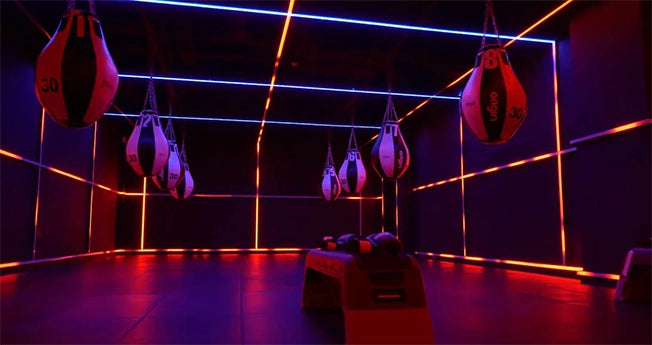
Set the pace. Change the atmosphere.
Think beyond a single bright setting. A studio may need a welcoming arrival, focused training, a high-energy class and a calmer finish. Start with what happens in each zone, then plan the lighting and controls together.
Plan the experience
Use a considered white-light scene for arrival, setup and equipment checks. Plan mirrors, circulation routes and staff areas alongside the feature lighting.
Colour can frame a training zone or turn a ceiling into part of the class experience. Decide whether you need one colour across a run, separate zones or moving effects.
Give instructors a simple way to select a calmer scene between sessions. Plan usable white light for cleaning and maintenance as part of the same brief.
Real spaces. Real movement.
A static photograph only tells part of the story. Watch the RISE and Cadence installations, then use the ideas to shape the brief for your own studio.
A cage of linear light gives the training space a clear visual identity, with practical white light and dynamic scenes for classes.

See how light becomes part of the ride. The control interface matters as much as the lighting effect when instructors need to change a scene during a session.


Define the scenes before choosing the controls. These examples show a useful way to brief the project, rather than a promise that any single strip or controller can deliver every effect.
Arrival, setup and equipment checks.
Class scenes and feature lighting.
Lower-energy sessions and a gentle finish.
Illustrative scenes. Final appearance and control behaviour depend on the specified system and the room.
Choose the behaviour, then the hardware
These are different lighting jobs. A colour-changing strip does not automatically create travelling patterns, and an addressable strip still needs the right controller and a planned power and data layout.
| Approach | What it gives you | Plan for |
|---|---|---|
| White light | A practical white-light scene. Adjustable-white systems let you change the white-light tone. | Choose fixed or adjustable white for the task, then specify suitable dimming and controls. |
| RGB / RGBW colour | Colour changes together across each controlled run. RGBW adds a separate white channel. | Select the required channels and group the areas that should change together. |
| Addressable PixelStrip | Individually controlled pixels or groups can create patterns and movement. | Plan a compatible controller, effect content, data routing and the power arrangement together. |
The details that make the result
A good feature should look considered when it is off, work clearly when it is on and remain accessible after the fit-out. Include these decisions in the brief from the start.
Decide which lines are seen directly and which wash a surface. Profile shape, diffuser, mounting position and viewing distance all affect the finished appearance.
Mark likely equipment positions and cable paths on the room plan. Feed arrangements depend on the chosen strip, run lengths and electrical design; a long visible line need not mean one continuous powered run.
Describe who changes the scenes, how quickly they need to do it and whether different areas need independent control. A simple everyday interface can sit alongside a more involved lighting design.
Think about how equipment will be reached, identified and maintained. For a multi-site rollout, share what should stay consistent and what changes from venue to venue.
Yes, independent behaviour can be planned into the system. Mark which areas should change together and which need their own scenes. This affects the control layout, wiring and the way the operator selects a scene.
Yes. A marked-up plan, photographs and a description of the desired effect provide a useful starting point. Include dimensions, ceiling height, access, timetable and a budget range so the discussion has practical context.
Share the opening date and any earlier design, first-fix or fit-out milestones in the enquiry. The team can discuss the scope and programme; a project example is not a delivery or installation-time guarantee.
An idea, installed
At RISE, a bespoke light cage combines functional white light with dynamic, audio-responsive lighting for classes. The same case study also explores Cadence Indoor Cycling Studio. See the original project stories, photos and posts before planning your own space.
See the RISE & Cadence projects ↗From first sketch to fit-out
Send room dimensions, ceiling height, mirror positions and a sketch of your training zones. Photos and marked-up plans help us understand the actual installation.
Tell us what happens in the room, how often the lighting changes and who will operate it. Music-responsive effects need a suitable control design; they are not a feature of every colour-changing strip.
Include available power, accessible equipment positions, your fit-out timetable and a budget range. We can discuss strip, profiles, preparation and control choices as one project.
Use these ranges to explore the possibilities. Your project brief determines which strip, profiles, power and controls belong together.
Yes, a project can be planned around different activities and scenes. The strip, power and controls need to be selected together. Tell us which areas require usable white light and where you want colour.
No. Conventional RGB or RGBW changes the colour of a controlled run together. Addressable PixelStrip can create effects across separate sections when paired with suitable control equipment. We can help match the approach to the class experience.
These projects are planned around the room, installation and desired effect. Start an enquiry with dimensions and your brief so the team can discuss the right approach. The case studies show previous projects rather than an off-the-shelf kit for every gym.
Share the space, the effect and the practical details. We will help turn them into a lighting plan.
Start Project Enquiry